I grew up close enough to Orlando that “line management” felt like a life skill, and I spent years in hospitality planning events where minutes mattered. Escape rooms scratch that same itch: high-energy fun, tight timelines, and the satisfaction of watching a plan actually work. The best part is you don’t need to be a puzzle genius to win. You need a system.
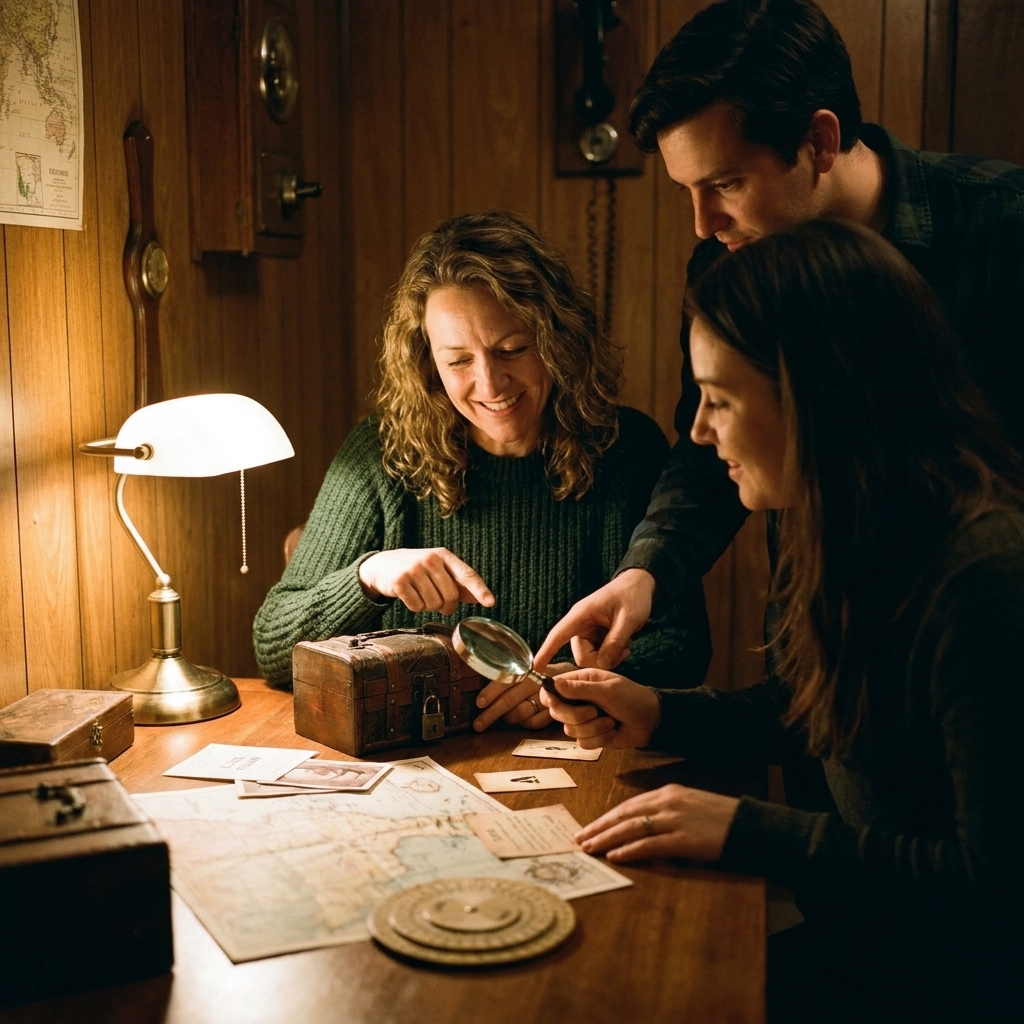
This is my first-timer strategy guide for improving your odds in almost any escape room, whether you’re rolling with your family, a date night duo, or a group chat that finally made plans.
Before you enter: pick the right room
Choose “beginner” or “family-friendly” if you want a real shot
Difficulty labels are not a challenge to your pride; they are a time-and-fun forecast. For your first room, choose beginner, moderate, or family-friendly. You’ll still feel clever, I promise.
- A good first-timer group size: Often 4 to 6 people, but always check the room’s posted minimum and maximum. Some rooms shine with 2 to 4, others want 6 to 10.
- Ask one question at check-in: “Is this room more searching or more puzzles?” If it’s search-heavy, you’ll want stricter organization from minute one.
- Linear vs. non-linear is a tradeoff: Linear rooms can feel calmer (less chaos), but they can also create a bottleneck where everyone waits on one clue. Non-linear rooms allow parallel progress, but they demand better communication. Pick what fits your group.
Dress like you’re about to move furniture
Wear comfy shoes, skip dangling bags, and keep pockets minimal. You’ll crouch, reach, and pivot a lot. If you have long hair, tie it back. If you wear glasses, bring a cleaning cloth because foggy lenses plus dim lighting is a whole thing.
The 60-second team huddle
Do this right before you start. It sounds nerdy. It wins games.
Assign simple roles (one person can do more than one)
- Captain (Coordinator): Keeps everyone talking out loud, tracks what’s solved, and makes the final call on where to focus next.
- Search Lead: Organizes the initial sweep and creates a “clue table” or “clue zone.”
- Puzzle Lead: Handles pattern-based puzzles, ciphers, logic, and anything that looks like “sit and think.”
- Inventory Manager: Holds the keys, collects found items, and prevents the classic “we found this 20 minutes ago” tragedy.
Agree on two rules
- Rule #1: Say everything out loud. If you find a key, read a note, notice a symbol, or open a drawer, narrate it. Quiet clue hoarding kills momentum.
- Rule #2: Reset after you solve something. Put used items in one spot, keep active items in another. Visual clutter is the enemy.
If you’re playing as a couple, you can still assign roles. One of you searches while the other starts working any puzzles that are already visible. Swap every 10 minutes if needed so no one feels stuck.
Room rules in 30 seconds
A quick etiquette check keeps you from losing time (or getting scolded):
- Don’t use your phone unless the venue says it’s allowed.
- Don’t brute-force locks. If it’s not turning, you’re probably not there yet.
- Ask before moving furniture, lifting rugs, or messing with anything that looks like set dressing.
- Don’t peel, pry, or unscrew props. If it needs force, it’s almost never the solution.
- Don’t pocket items. Ever. (More on this later.)
The opening rush
The first 5 to 8 minutes should feel like a coordinated scavenger hunt, not a free-for-all.
Do a clockwise sweep
Pick a wall and move around the room clockwise. Open what can be opened, look under what can be safely moved, and scan for anything that looks intentionally placed.
- Check drawers, shelves, book spines, framed pictures, corners, under rugs (if allowed), and the underside of tables.
- Look for patterns: repeated colors, numbers, animals, shapes, or arrows often matter later.
- Spot “do not touch” cues: anything bolted down, marked off, or clearly part of the room set dressing.
Create a clue zone
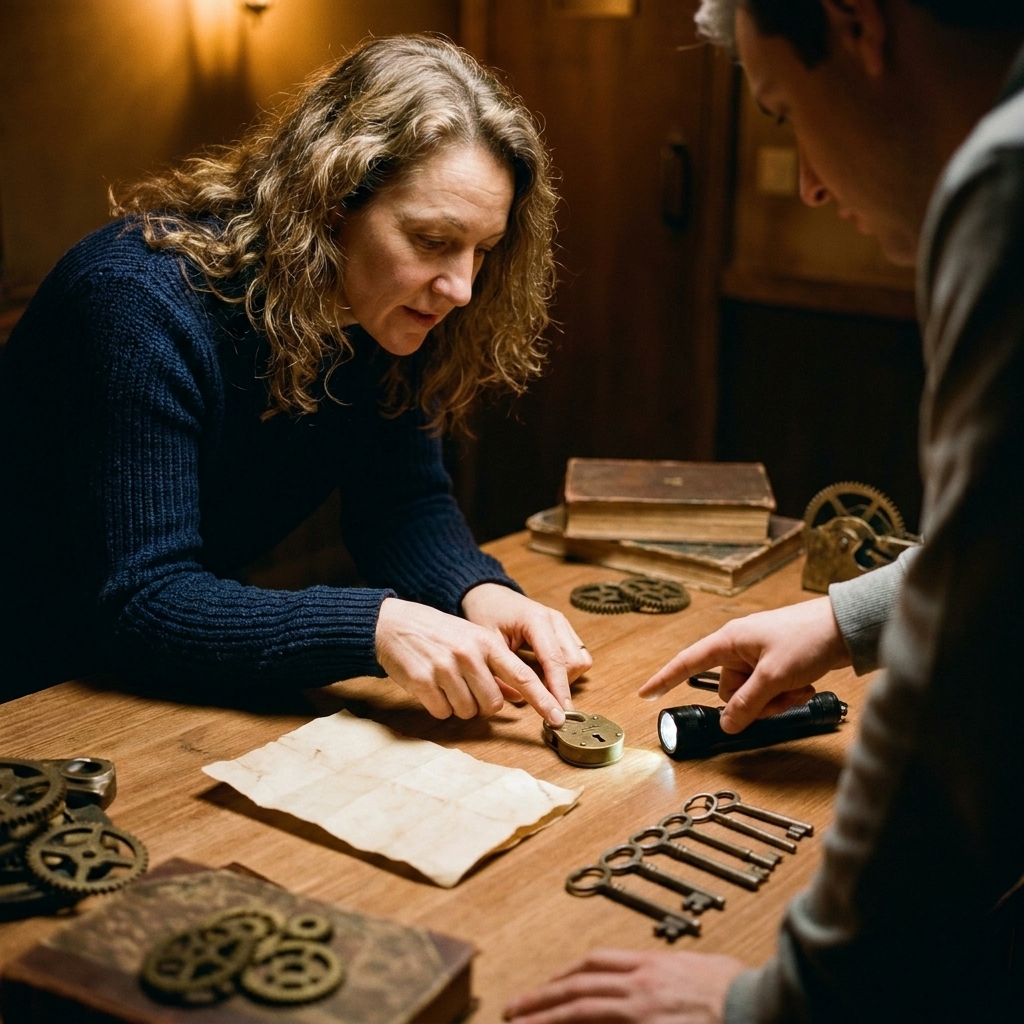
Pick a single surface (table, bench, desk) and place everything found there. Keep it tidy. You’re building a shared brain.
Handle locks the right way
Some rooms still use classic padlocks, and some modern rooms barely use locks at all. You might see a mix of:
- Key locks
- 3-digit and 4-digit combination locks
- Letter locks
- Directional locks (up, down, left, right)
- Electronic triggers like maglocks, RFID, touchscreens, sensors, or “something clicked and the drawer opened” moments
Best practice: when you find a portable lock and the venue allows it, bring it to the clue zone. Don’t leave it attached to a box across the room while three people guess at it. Centralizing reduces duplicate work.
Communication that works
Use “I have” and “I need” language
This is the fastest way to connect clues to puzzles:
- “I have”: “I have a card with three moons and a triangle.”
- “I need”: “I need a four-digit code for this brass lock.”
It sounds simple, but it forces your team to broadcast status in a way others can act on immediately.
Read text to the group
Read each discovered note out loud at least once to everyone. If it’s dense or clearly important, read it again when you move it to the clue zone. Escape rooms love tiny details: a single underlined word, an odd capitalization, or a weird punctuation choice.
When you’re stuck, summarize instead of spiraling
If more than two minutes pass with no progress, the Captain should do a quick reset:
- What did we just solve?
- What new items did it give us?
- What locks or “needs” remain?
- What puzzles are currently in progress, and by whom?
This prevents the most common first-timer trap: everyone working hard, nobody moving forward.
How to track info
One notepad, whiteboard, or phone-free scratch pad (if allowed) can save you from repeating work.
- Make a “Needs” list: “4-digit lock,” “letter lock,” “directions,” “keyhole,” “keypad,” “RFID spot.”
- Write codes with context: “7341 (from painting colors)” beats “7341???”
- Mark attempts: If you tried 2580 on the 4-digit lock, write it down so you don’t re-try it in a panic later.
Common puzzle types
You don’t need to know every cipher. You just need to recognize categories and apply the right approach.
Pattern and matching
These include colors, shapes, symbols, and sequences. Strategy:
- Look for repetition across the room.
- Check if the puzzle wants order (left-to-right, tallest-to-shortest, clock positions).
- Count things. Seriously. Count corners, dots, lines, or items in a set.
Word and letter
These include riddles, anagrams, and letter locks.
- Try the obvious first: themed words tied to the room story.
- Look for acrostics (first letters of lines) and highlighted words.
- If you get a set of letters, ask: is this meant to be sorted by something in the room (colors, pictures, numbers)?
Number and code
These include 3-digit and 4-digit locks, dates, and counting tasks.
- Confirm the required length before guessing.
- If you have more numbers than you need, you probably need an ordering key (like colors, directions, or a numbered list).
- Write it down. Memory is unreliable under a ticking clock.
Physical and mechanism
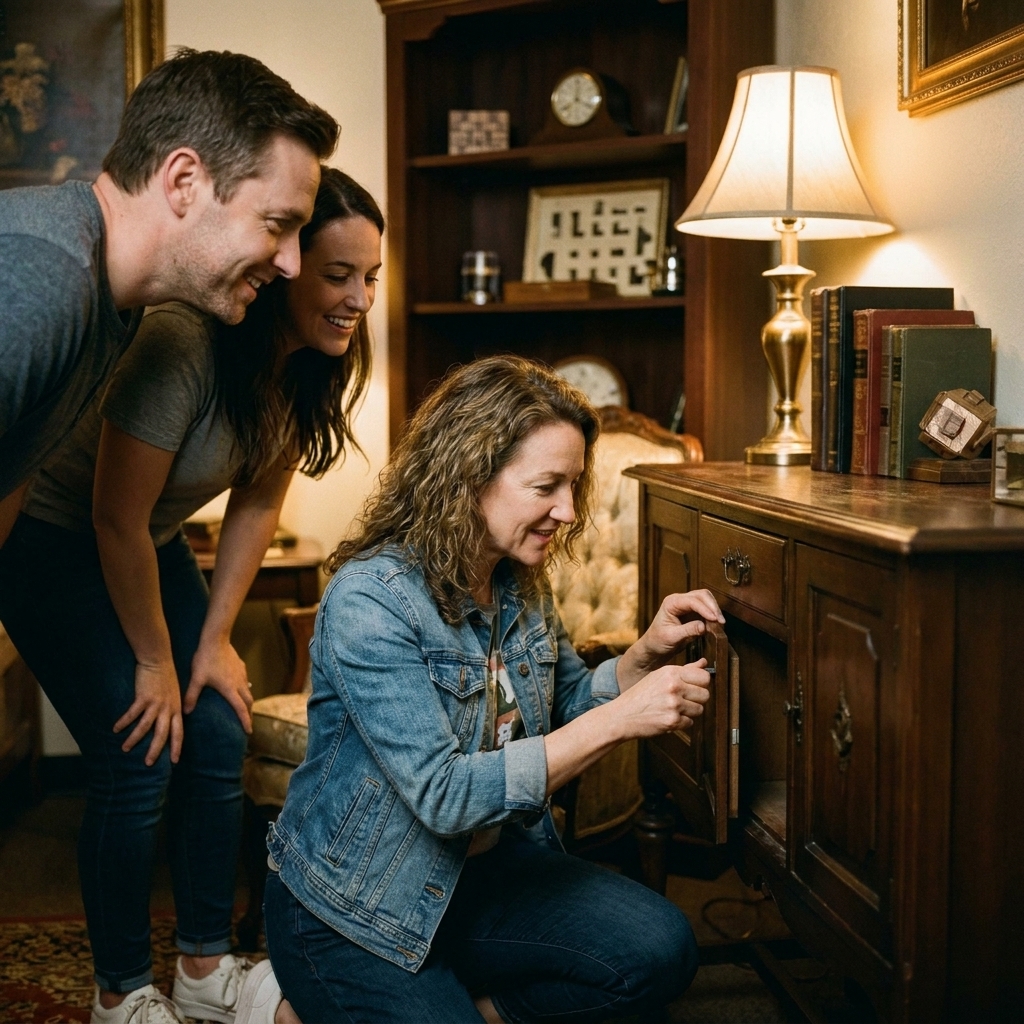
Magnets, sliders, hidden compartments, pressure triggers, and moving pieces.
- Be gentle and deliberate. If it requires force, it’s probably not the solution.
- Use two-person handling for anything delicate or awkward: one manipulates while the other observes.
- When something clicks open, announce it immediately so the team can pivot.
Hint strategy
Hints are not a moral failing. They are a tool. Your goal is to keep the game moving so the fun stays high.
My “5 and 25” guideline
- First hint by minute 25 if you haven’t solved at least one major lock or puzzle chain.
- Hint after 5 minutes stuck on a single step, especially if multiple people are now stuck on it too.
Ask for the right kind of hint
Instead of “Help,” ask for one of these:
- Confirmation: “Are we using the right objects for this puzzle?”
- Next-step nudge: “What should we focus on next?”
- Interpretation: “Are we reading this clue correctly?”
This keeps the win feeling like your win, while still protecting your clock.
Classic first-timer mistakes
1) Pocketing items
Don’t stash keys, notes, or pieces in pockets. Items vanish into the void, and suddenly the whole team is blaming the room. Put everything in the clue zone unless it’s actively being used.
2) Not trying the obvious
New players often assume the solution must be complex. Try the simple stuff:
- Enter the code you just found into the lock you just found.
- Try the key on every keyhole you have.
- Line up objects that look like they belong together.
3) Solving silently
If you crack a puzzle and don’t narrate it, you create duplicate work and confusion. Say what you did, what it produced, and what you think it opens.
4) Getting stuck on one puzzle too long
Many rooms are designed with multiple paths, so you can rotate when your brain hits a wall. If your room is more linear, the same advice still helps: swap who’s looking at the problem, change your angle, or ask for a nudge before frustration eats the clock.
5) Ignoring the story
The theme is not just decor. Story beats often tell you what to look for: a missing artifact, a sabotage, a secret recipe, a prison break. The narrative can guide your next search area.
Minute-by-minute plan
Minutes 0 to 8: Full sweep
- Clockwise search, announce everything.
- Build the clue zone.
- Identify all visible locks and “needs” (3-digit, 4-digit, letters, keypad, sensors).
Minutes 8 to 25: Parallel solve
- Split into pairs: one searches deeper, one works puzzles.
- Open easy wins fast to generate momentum.
- Keep solved items in a separate “done” pile.
Minutes 25 to 40: Tighten communication
- Captain does a status recap every 5 to 7 minutes.
- Use your first hint if progress is slow.
- Re-check earlier clues with new context.
Minutes 40 to end: Finish mode
- Stop random searching. Focus on unresolved locks and active puzzle chains.
- Use hints faster. This is not the time for stubbornness.
- Assign one person to keep the clue zone organized so you don’t lose final pieces.
Families, couples, and solo tips
Families with kids
- Give kids a job: “Find anything with animals,” “Count all the stars,” “Match these symbols.” It keeps them engaged and surprisingly useful.
- Use a physical “parking spot” for items they find so nothing walks away.
- Let them announce discoveries. It boosts confidence and helps the team.
Date night or two-person teams
- Do a tighter sweep and keep items on one surface. With two people, organization is everything.
- Say what you’re doing as you do it. Quiet concentration can look like secretiveness under pressure.
- If you disagree, test both ideas quickly rather than debating. Time is your only real enemy.
First-time solo (if your venue allows it)
- Choose an easier room and confirm how hints work.
- Centralize everything and write down every code attempt and result.
- When stuck, change location. A new angle often reveals hidden details.
After the game
Ask the game master for a quick debrief. The best venues love sharing:
- Which puzzles you skipped or misunderstood
- How many minutes you were from the end
- What the “aha” moment was for any major bottleneck
Also take a mental note of what your group did well. Maybe you searched like pros but got stuck on ordering codes. Or you solved puzzles quickly but missed hidden compartments. That tells you exactly what to focus on next time.
My favorite escape room teams are not the loudest or smartest. They’re the ones who stay organized, talk constantly, and treat every clue like it’s meant to be shared.
Quick FAQ
Are escape rooms scary?
Most are suspenseful rather than truly scary. If you don’t like jump scares, choose mystery, heist, adventure, or family themes. Horror rooms usually advertise themselves clearly.
Can you ask for unlimited hints?
It depends on the venue. Some offer unlimited hints, others limit hints or add time penalties. Ask at the start so you can plan your pacing.
What if we accidentally break something?
Stop, tell the game master, and don’t try to “fix” it. Most rooms are built to handle lots of hands, and staff prefer quick honesty over mystery damage.
What is the single best tip to win?
Say everything out loud. Escape rooms are communication games wearing puzzle costumes.